Native plants and keystone plants are both vital to ecosystems, but they serve different roles. Native plants are species that have evolved in a specific region over time and are adapted to the local climate, soil, and wildlife. They support native biodiversity by providing food and habitat for local fauna. Keystone plants, on the other hand, are a subset of plants that have an outsized impact on their ecosystems, regardless of whether they are native. While many keystone plants are native, not all native plants are keystone species. Preserving both native and keystone plants is essential for maintaining biodiversity and ecological stability. Learn more about Keystone Plants Here.
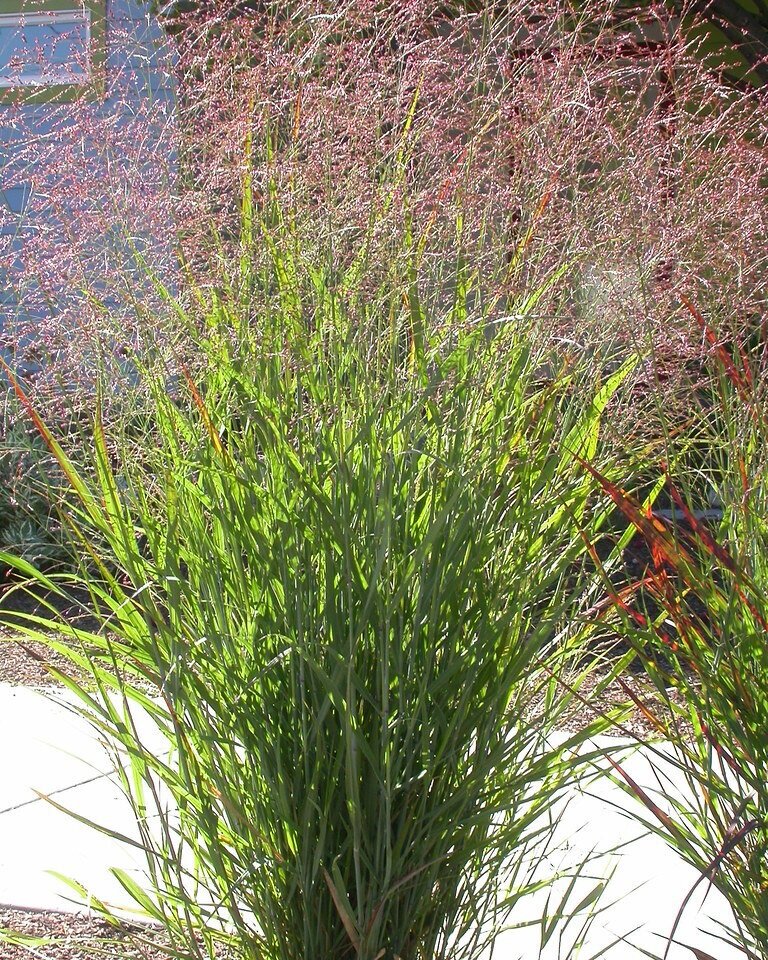
Ornamental grasses bring year round interest to a landscape and most are very low maintenance. Many of the best selections are native to North America. At the Madison Native Plant Gardens at the Madison County Library in Marshall, native grasses play a major role and are one of a number of themed gardens. It’s a wonderful place to get a good look at native grasses that grow well in our region, especially if you are considering adding a few to your own landscape. And, late summer and fall is a great time to visit, when leaves start to change color and many grasses produce attractive seed heads. Notice how their leaves and seed heads sway in the wind, adding gentle movement to the garden.
Among the most versatile native grasses is switchgrass (Panicum virgatum), a perennial, warm season grass that is native to most of the U. S., east of the Rocky Mountains. At one time, it was a major component of the tall prairies, before they gave way to large-scale cultivation. It can still be found in the wild in both wet and dry meadows, along roadsides and at woodland edges. That range of habitats attests to its adaptable nature—it’s easy to grow on almost any sunny site. A number of very attractive cultivars of switchgrass can be grown in Western North Carolina and they range from 3′ to over 7′ high, have foliage colors that range from bluish green to reddish, and feathery seed heads that are light green, purple, or bright white.
In the landscape, switchgrass can be planted as a specimen, combined with other perennials in a bed or border, or massed—it’s a great erosion preventer. Taller varieties make effective screens, and its seeds provide food for wild birds. In addition to its value in the home landscape, switchgrass has been used extensively along highways and median strips for erosion control. It also shows promise as a biomass crop for producing alternative energy. These grasses tolerate poor soil and drought and once established are very low maintenance. Their one requirement is to be cut back to within a few inches of the ground in late winter or early spring, before the new leaves emerge.
Our native species typically grows three feet tall. In late summer, flower stems with airy, purple-green seed heads rise several inches above the foliage. The effect is light and graceful—in contrast to its tough-as-nails nature. In fall, the leaves turn gold or rusty brown, and they remain attractive into winter. There are three distinct varieties of switchgrass growing in the Library Gardens, they can be found both in the island bed that contains the seating deck, and on the steep banks surrounding the parking lot.
In the landscape, switchgrass can be planted as a specimen, combined with other perennials in a bed or border, or massed—it’s a great erosion preventer. Taller varieties make effective screens, and its seeds provide food for wild birds. In addition to its value in the home landscape, switchgrass has been used extensively along highways and median strips for erosion control. It also shows promise as a biomass crop for producing alternative energy.
These grasses tolerate poor soil and drought and once established are very low maintenance. Their one requirement is to be cut back to within a few inches of the ground in late winter or early spring, before the new leaves emerge. Our native species typically grows three feet tall. In late summer, flower stems with airy, purple-green seed heads rise several inches above the foliage. The effect is light and graceful—in contrast to its tough-as-nails nature. In fall, the leaves turn gold or rusty brown, and they remain attractive into winter. There are three distinct varieties of switchgrass growing in the Library Gardens, they can be found both in the island bed that contains the seating deck, and on the steep banks surrounding the parking lot.
‘Cloud Nine’ is one of the tallest varieties; it grows seven to eight feet tall, and has blue-gray foliage that turns gold in fall. It bears soft, billowy seed heads in mid summer, which persist into early winter.
‘Dallas Blues’ grows five to six feet tall. Its leaves are a steely blue, which contrast beautifully with its soft pink seed heads.
‘Shenandoah’, sometimes called red swithchgrass, grows three to four feet tall, with an upright habit. Its leaves change from green with red tints in summer to a full-blown burgundy-red in fall. The late summer seed heads are reddish pink.
When you visit the gardens, be sure to pick up a brochure on the Native Grasses near the gazebo. It will help you identify the three switchgrass varieties as well as pink and white muhly grasses, river oat grasses, and other native grasses that are on display and labeled with metal markers in that garden.
Consider moss. This simple, one inch high plant is easy to grow in shady places where grass is reluctant to provide more than a few sparse, unhappy blades. Moss likes nutrient poor and compacted soils, is not fussy about pH, doesn’t require fertilizer, never needs to be mowed and is evergreen if kept moist. It survives periods of drought by going dormant and turning brown but, unlike most other plants, it quickly revives to a beautiful emerald green when watered.
Moss is an excellent ground cover for ferns and other woodland plants and shrubs and can be used in place of invasive species like myrtle and ivy. Other than occasional light watering, the only maintenance moss requires is blowing off debris and fallen leaves. Since a thick carpet of moss is weed resistant, not much weeding is required.
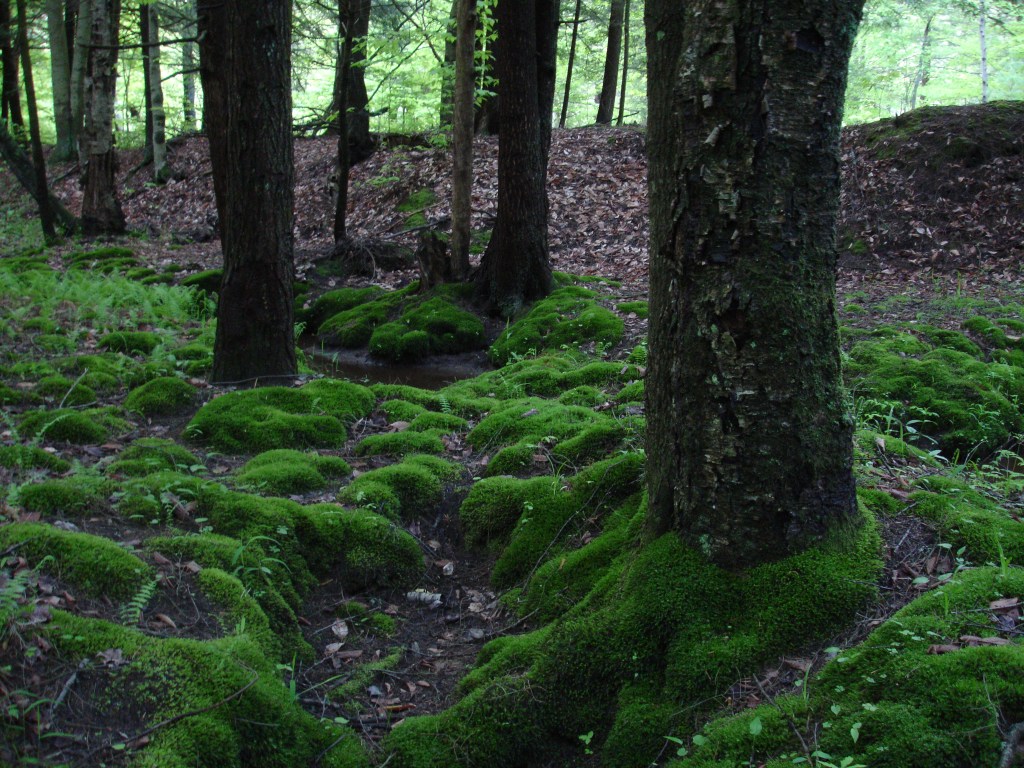
Here’s how to start your moss garden: choose a shady place and remove all weeds and debris such as small rocks, branches and leaves. (You can use a pre-emergent like Preen to prevent existing seeds from germinating.) Moss likes to be in direct contact with the soil, so it helps to lightly scratch the soil surface to help moss attach. Once planted, water it and walk on it once, lightly. In Madison County moss loves to grow in shady lawns and woods. Some people dislike moss and are happy to have you pull up a clump or two and carry it off. A large clump of moss can be divided into many tiny pieces.
Another way to get moss is to propagate it yourself. Before you try this make sure the person who cooks and cleans your kitchen is away on a shopping spree. Here’s a recipe. Mix a large clump of moss and 2 cups of buttermilk in a blender. (Some people add ½ cup beer and ½ cup sugar). Blend to the thickness of a milk shake and spread or paint on rocks, pots, logs and even the ground. For further inspiration and some wonderful photos check the web. The quiet beauty of a moss garden inspires peacefulness and rest. Add a small bench, bring out your morning coffee and enjoy.
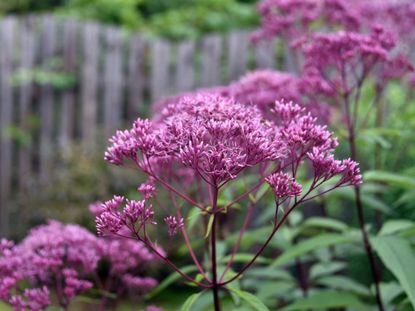
The next time you visit the library, walk past the main entrance and take a moment to admire the large Joe Pye Weed growing in the gardens in front of the deck. Reaching up to seven feet tall or more, these wildflowers have hollow purple stems, bright green leaves in a whorl around the stem and beautiful, dusty pink flower clusters that can reach eighteen inches across. The flowers of Joe Pye Weed are attractive to large butterflies and a great addition to a butterfly garden. If you come upon this plant in the morning you may be struck by how the purple stems, deep maroon petioles (where the stem attaches to the leaf) and bright green leaves glow in the sunlight.
Joe Pye Weed is believed to be named after a doctor who lived in colonial New England and made a tonic with its roots. It flowers in Madison County during August and September and can be planted at the back of a border or mixed with shrubs. It can also be seen growing wild along roadsides. It is considered an herb.
Joe pye weed thrives in full sun to part shade in average to rich, moist soil. They are adaptable to just about any soil type but their best growth is when there is consistent moisture. If you aren’t able to provide enough moisture choose a location with protection from the hot afternoon sun. Joe-Pye weed is native to swamps, wet meadows and the edges of streams, lakes and ponds, so it really does enjoy moist conditions, but at the same time it is highly adaptable to any good soil with frequent watering. In drought conditions, Eupatorium will wilt and the leaf edges may turn crispy but plants will recover once moisture returns. Plants grow from a main crown that spreads underground. Plants are hardy in zones 3-7.
In the library gardens you will see a number of small, dwarf varieties suitable for smaller gardens. Two smaller varieties are Eupatorium dubium ‘Little Joe’ (growing 4′ tall) and Eupatorium maculatum ‘Gateway’ (growing 5′ tall). Plants or seeds for all of these lovely native plants can be bought at local nurseries or through mail order.
Purple passion-flower (sometimes called Maypop) is an herbaceous vine, up to 25 ft. long, that climbs with tendrils or sprawls along the ground. Intricate, 3 in., lavender and blue flowers are short-stalked from the leaf axils. The petals and sepals surround a fringe of wavy or crimped, hair-like segments.
Three-lobed, deciduous leaves are dark-green above and whitish below. The fruit is a large, orange-yellow berry with edible pulp. Like some other passion vines, Maypop spreads by root suckers and can become somewhat invasive.
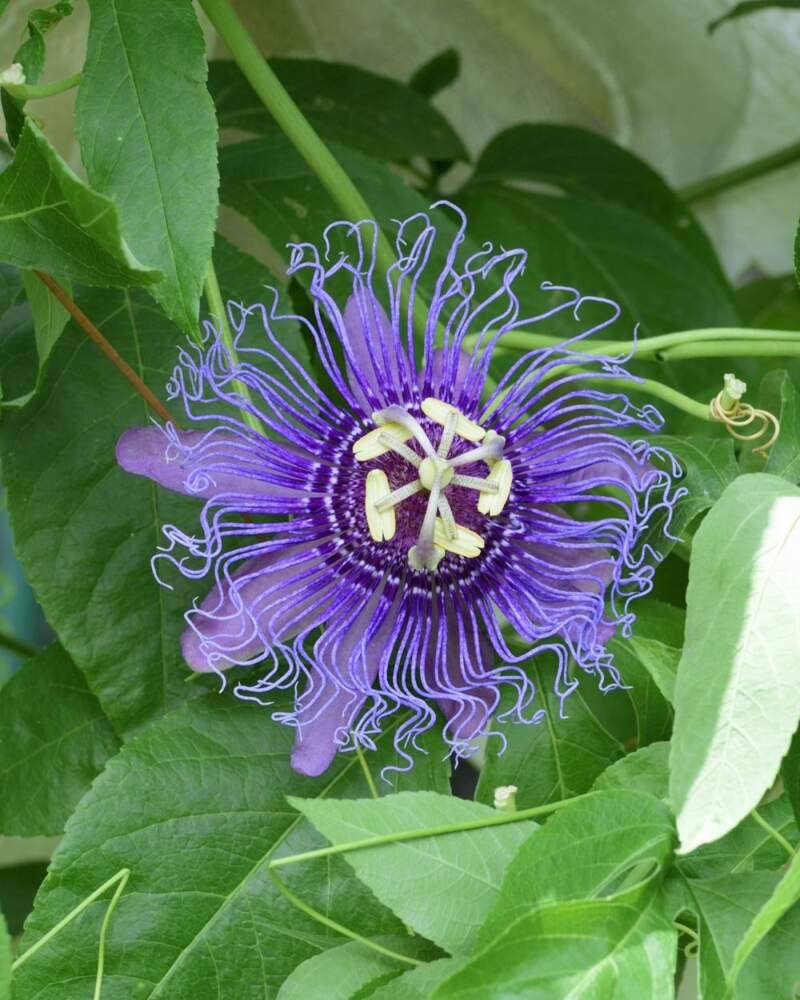
This plant with its striking and unusual flower is widely distributed in the Southeast. The plants were given the name Passionflower or Passion vine because the floral parts were once said to represent aspects of the Christian crucifixion story, sometimes referred to as the Passion. The name Maypop comes from the hollow, yellow fruits that pop loudly when crushed. The Cherokee Indians called it ocoee; the Ocoee River and valley in Tennessee are named after this lovely plant.
Passionflower occurs in thickets, disturbed areas, near riverbanks, and near unmowed pastures, roadsides, and railroads. It thrives in areas with lots of available sunlight. It is not found in shady areas beneath a forest canopy. This and other passionflowers are important because they are the exclusive larval host plants for several butterflies including the Gulf and Variegated Fritillaries. The flowers also attract hummingbirds while many birds and mammals eat the fruit.
Passionflower plants are available at many nurseries or online. They can also be grown from stem cuttings or from seeds collected from the mature fruit. Passionflower likes sun but will tolerate partial shade. It’s accustomed to poor soil, so give it a deep hole filled with sand and other soil lighteners, but don’t pamper it too much. Consistent watering is a good idea.
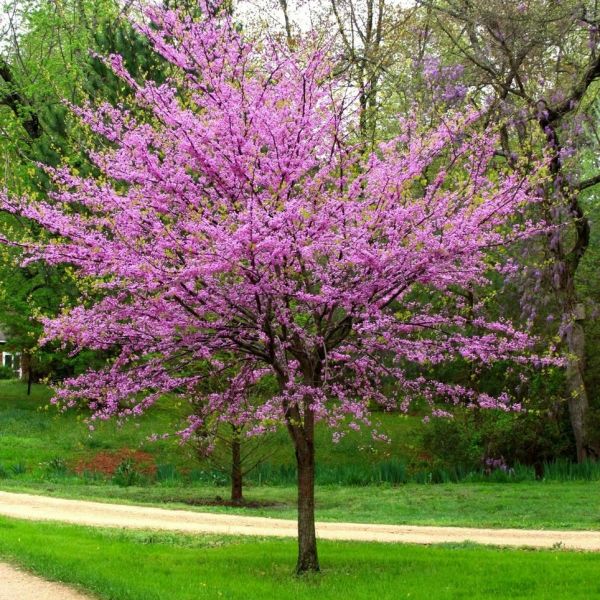
The lovely Eastern redbud is a native perennial, deciduous tree or shrub. When planted in shade, it grows dense and round, reaching about 15 ft tall but in full sun has an open, taller form, growing up to 30 feet.
Eastern redbud is a strikingly tree in the spring because it produces thousands of pink to lilac flowers before most other trees have begun blooming. The wood is heavy, hard, and close-grained, but because of the small size and irregular shape of the tree it is of no commercial value as a source of lumber. This tree is most valued as an ornamental and is extensively planted. The heart-shaped leaves are easily recognizable and add to the beauty of the flowers.
In the forest understory in moist rich woods, it’s commonly found along the banks of streams, in ravines, on bluffs, in open rocky woods, and abandoned farmlands. The tree is very graceful with arching branches that look lovely as a single plant, in groupings, and in shrub borders. They do well in soils of moderate to low fertility and are very drought resistant.
The seeds have very hard seed coats that require both chilling and scarification (cutting or scaring) for germination, unless planted in the fall. Cuttings are difficult to root. Mature plants do not transplant well so buy young plants that are balled and burlapped or container grown. Transplant the plants in the spring or fall, in well drained soils in sun to part shade. Though graceful and showy, redbuds are relatively short-lived and should be pruned to avoid weak forks, especially in trees with multiple trunks. Keep the lateral branches less than half the diameter of the main trunk, spacing branches 6 to 10 inches apart. Also note that these trees have thin bark. Special care should be taken to avoid damage.
Redbud is also known as “The Judas Tree” because, according to legend, Judas Iscariot used an old world relative of redbud to hang himself. This is why the tree is now so weak-wooded; it refuses to grow branches that would be strong enough to hang another.
American winterberry is a beautiful, ornamental, multi-stemmed shrub. Hardy in zones 3 through 9. It is also called black alder, brook alder and fever bush and is a member of the holly family. It is native to eastern Canada and the eastern half of the United States. Rarely reaching over 12 feet tall with an oval to rounded, upright shape. It tends to spread by suckering and forms large colonies. Winterberry is an easy to grow but tough shrub which can grow in average soil but prefers acidic soils and wetlands. It’s often found at the edge of woods or swamps. It grows well in either full sun or part shade, but more sun promotes better berry production.
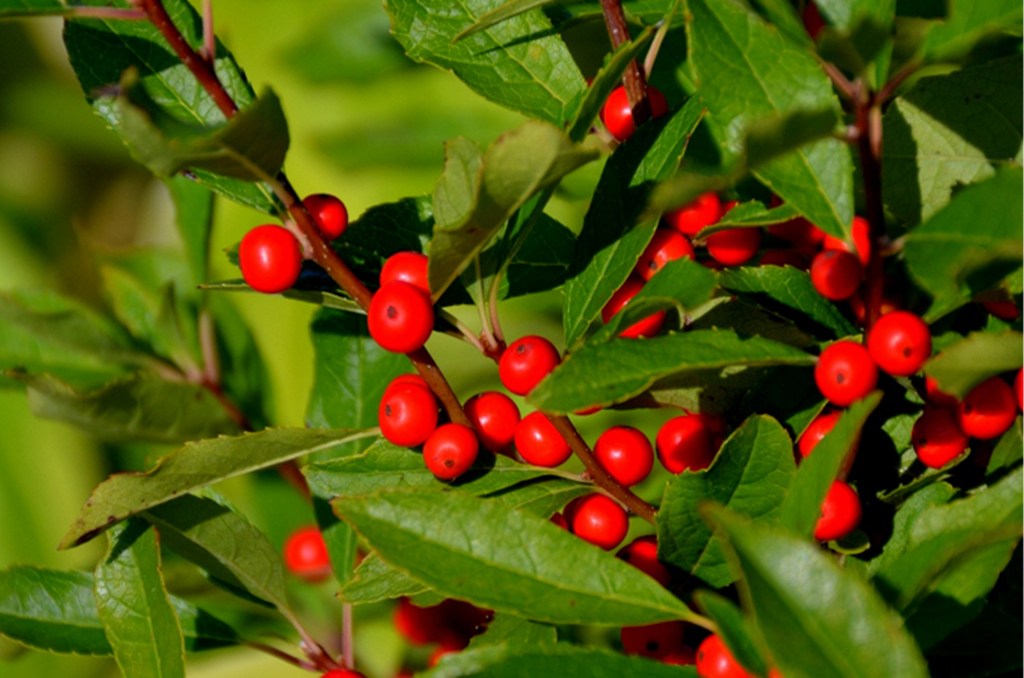
The leaves are finely toothed, glossy green leaves, narrow and oblong, turning shades of yellow, maroon or brown in fall before dropping off. In late spring and early summer, small, whitish, greenish or yellowish, inconspicuous flowers bloom on the axils. They are followed by a spectacular display of bright red berries so vivid it’ll make you stop and take notice.
As with most hollies, male and female plants are needed to produce berries. One male plant will be sufficient to fertilize a dozen female plants within a 40 foot radius. Flowers appear on new growth, so any pruning should be done in late winter to early spring. Identification between male and female hollies can only be positively accomplished by examining the flowers. Take a close look at the flowers, specifically, at what protrudes from their centers. Male holly flowers have 4 yellow stamens, each female holly flower has a green ovary (bump). For berries on Ilex verticillata, try one of these male pollinators, ‘Southern Gentleman’ or ‘Jim Dandy’.
Winterberry hollies are an excellent source of food for numerous species of songbirds as well as small mammals, wild turkeys, and quail. They are also eaten by white-tailed deer. Stems are often collected in November before the songbirds strip the fruit. The berry-laden branches are prized by arts and crafts enthusiasts for use in such items as floral arrangements, wreathes, kissing balls and winter window boxes.
There are very few species of evergreens native to Western North Carolina. The Fraser fur and red spruce are two of the most common. (The blue spruce is used in our area as an ornamental, but is native only to the Western states.) Unfortunately, the majestic hemlock is being attacked by an introduced insect, the wooly adelgid, and may eventually be wiped out in the wild.
One of the most beautiful evergreens found in our area is the American Holly, Ilex opaca. The tree was noticed by the Pilgrims who landed in North America the week before Christmas in 1620 on the coast of Massachusetts. This evergreen with prickly leaves and red berries reminded them of English holly which was a symbol of Christmas in England and Europe.
American Holly is slow growing but well worth the wait, although some cultivars approach 6 inches of growth per year. It grows into a small to medium tree of about 40′ to 50′ tall. Optimum growth can be encouraged by planting in moist, highly organic, acidic and well drained soil. It is very shade tolerant and works well as an understory plant but can also tolerate full sun. It also can be pruned as a durable hedge.
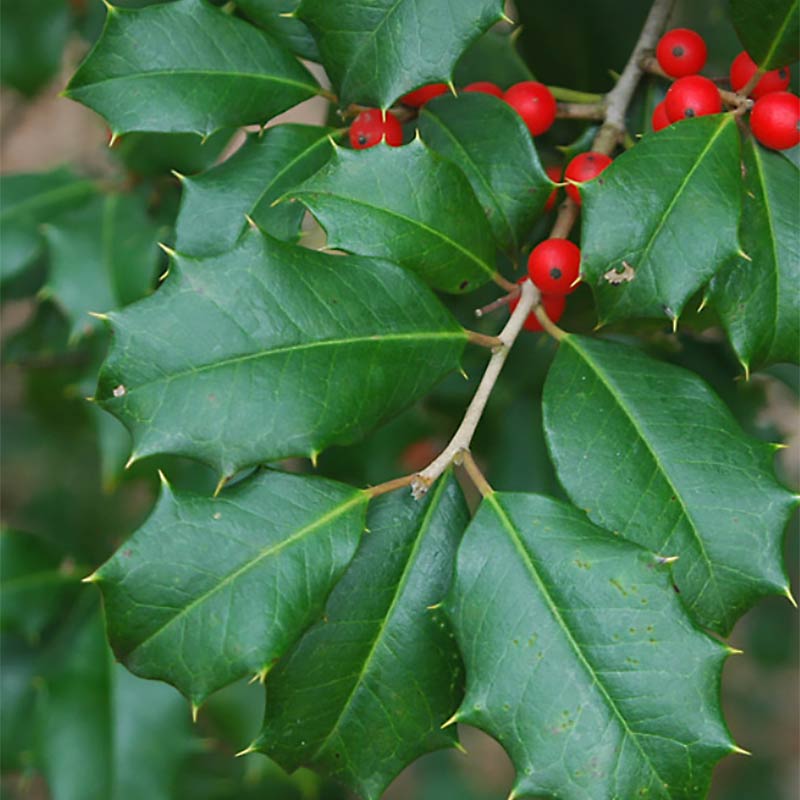
American Holly leaves are dark green, tough, and leathery. Sometimes they are very shiny while underneath, they are yellowish-green. Holly leaves have several “prickles” on the edges. The flowers are small and white and usually bloom from April to June. Hollies are dioecious, meaning that there are male and female plants. Both are needed for flowers to form. Both male and female plants need to be from the same variety. Only female plants produce the characteristic red berries. One male can pollinate several female plants. Pollination is accomplished by insects, including bees, wasps, ants, yellowjackets and night-flying moths.
The fruits are called drupes. The drupes are green and berry-like, turning to bright red in the fall. Drupes grow from September to November and stay on the tree through the winter. American Holly is a good food source for many animals including: wild turkey, mourning doves, cedar waxwings, American goldfinch, northern cardinal, and many other songbirds. Wood from the American holly is very pale, tough, close-grained, takes a good polish, and is used for whip-handles, engraving blocks, and cabinet work. It can also be dyed and used as a substitute for ebony. The sap is watery and contains a bitter substance which possesses tonic properties.
Holly is a popular winter and holiday decoration. In English poetry and stories the holly is inseparably connected with the merry-making and greetings which gather around the Christmas holidays.
This native viburnum, often called possumhaw or winterthur, has it all! It is one of about 150 species which grow worldwide. Most Viburnums make terrific garden plants because of their dependability and their stunning flowers and fruits. Viburnum nudum is one of the most beautiful and hardy plants of the genus. It offers showy, creamy white flowers in spring, glossy green foliage in the summer, edible, magnificent colored berries that birds love, vibrant reddish-purple leaves in the fall. This shrub has an upright structure with beautiful branch color in the winter. It has a speedy growth rate. Its versatile for use in the landscape and adaptable to varied conditions of soil and light exposure. This species is a natural for gardens.
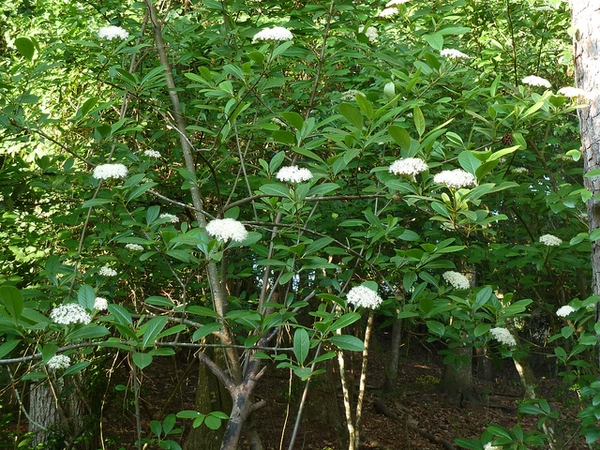
Viburnum nudum likes full sun and average garden soil. It tolerates light shade but flowers and fruit are more abundant with as much sun as possible. It has no preference for either wet or dry soil, and does well in both soil conditions. Possumhaw responds to yearly fertilization and light pruning. Even in the wild this species is dense and well shaped with no extra help. The size of this shrub makes it a perfect choice for all but the smallest gardens. Even in a tiny garden it could be used as a small tree. Its upright habit and branch structure allows it to show off its attractive smooth, tan bark.
It is easy to propagate. Seeds are viable and require no pretreatment for germination. However, softwood cuttings are much faster and easier than seeds. Cuttings are easily rooted and very fast growing if made during mid summer. Cuttings made in July produce a good gallon size garden-ready plant by the following spring if the cuttings are fertilized with a slow release fertilizer during warm weather.
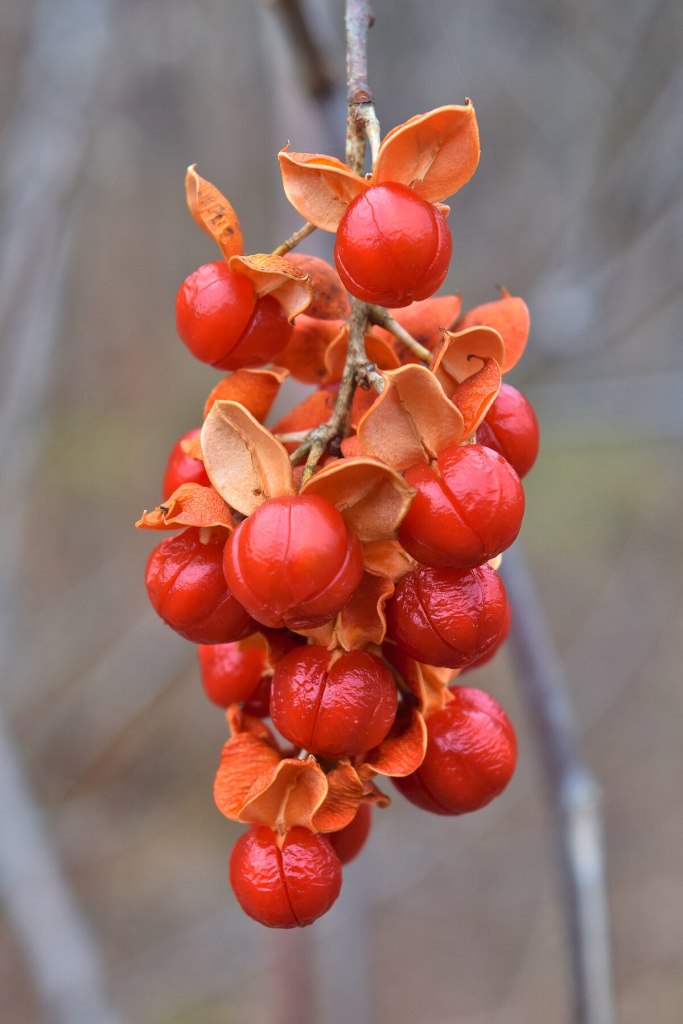
American bittersweet is a deciduous twining woody vine that is best known for its showy red berries that brighten up fall and winter landscapes. Hardy in zones 3 to 8. Native to central and eastern North America and generally found in woodland type environments. The plant quickly grows 15-20 feet with a spread of 3-6 feet. Plants bloom in May to June.
These plants are primarily dioecious (separate male and female plants), although some have a few perfect flowers. Female plants need a male pollinator to produce the attractive fruit that is the signature of this vine. Staminate and pistillate (male and female) flowers appear in clusters on separate plants in late spring. Flowers are greenish-white to yellow. Fertilized female flowers give way in summer to spherical orange-yellow fruits. Fruits split open in fall to reveal scarlet fleshy berry-like seeds (arils). Fruits are poisonous if ingested, but are considered to be quite tasty by many birds.
Unfortunately, some nurseries do not sell the vines as male or female (as is commonly done with hollies). Generally one male plant is needed for 6-9 female plants. Female plants may be vegetatively propagated to create more female plants. American bittersweet grows best in lean to average soils with regular moisture in full sun. Lean soils help restrain growth. Will grow in part shade, but needs full sun for best flowering and fruit display.
Vines may be grown on structures or allowed to ramble along the ground. It is generally best to avoid growing vines up small trees or through shrubs because vines grow rapidly and can girdle (strangle) trunks and branches causing damage and sometimes death. Vines sucker at the roots to form large colonies in the wild. Vines will also self-seed, often with a little help from our feathered friends. Prune in late winter to early spring. Mature vines require minimal pruning other than removal of dead or excess growth. Berry-laden branches are prized for use as indoor decorations and floral arrangements. Collection of the branches in the wild has significantly reduced the wild populations in some areas.
Both of these perennial native plants produce beautiful flowers, whether bright orange or the softer purple/pink blooms. Their rich nectar attracts an abundance of insects, including the butterfly. The insects feed on the leaves, seeds, stems, or roots of the plants,. My favorite is swamp milkweed, Asclepias incarnata ‘Cinderella’ which has a pink flower. Milkweeds are the only host plants for the monarch butterfly.
Most milkweed prefer full sun. They grow 24″-36″ tall with a spread of about 24″. The Asclepias tuberosa grow a bit shorter. Milkweed bloom mid to late summer. Swamp milkweed has a preference for moist but well drained soil. The others need good drainage but prefer a drier soil. Plants are low maintenance and attract hummingbirds, butterflies, bees and beneficial insecsts. Swamp milkweed has a wonderful vanilla scent.

Being the only genus of plants that host the Monarch caterpillars, it means the foliage will be chewed, and if you are very lucky, covered with caterpillars! Do not disturb roots when transplanting purchased pots. Most varieties will not survive transplant from one garden site to another since they have a very long tap root. Plants are poisonous if ingested in large quantities, especially children.
Here’s a great website for information on monarch butterflies and their connection with milkweed plants: http://butterflysocietyofva.org/growing_milkweed.htm
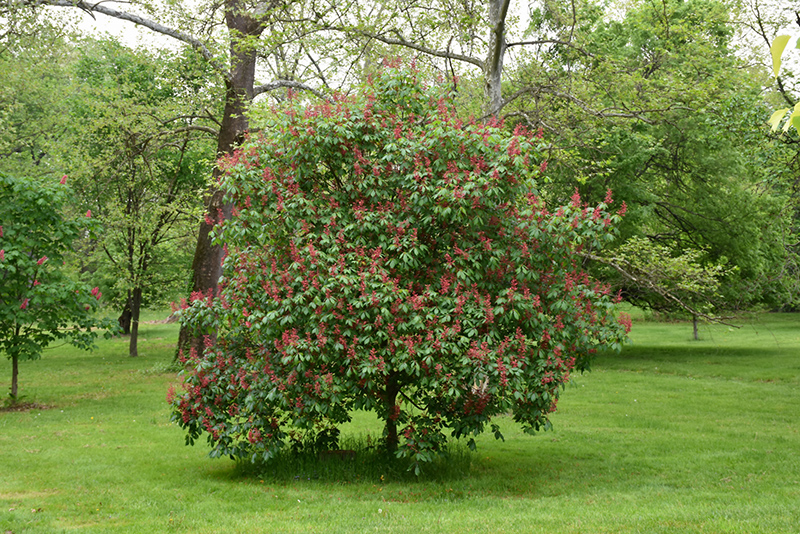
The nut of the red buckeye grows in clusters of three. It is toxic, generally ignored by most animals and is difficult to ingest. Don’t confuse it with a chestnut, since they look similar. There is a saying that to keep a buckeye nut in your pocket or purse will bring good luck.
The Red Buckeye is a beautiful tree in a shade to semi-shaded area. It produces abundant clusters of tubular red flowers as early as the second or third year after planting. It is native to the southern and eastern parts of the U.S. It has a number of local names, such as scarlet buckeye, woolly buckeye and firecracker plant.
The Red Buckeye is usually a single stemmed, small tree reaching generally 10-12 feet tall. They have interesting leaves which are 5-10 inches across. Leaves emerge a velvety purple-green in color. The showy red flowers are arranged on terminal spikes and appear along with the leaves in early spring. There are several cultivars: ‘Atrosanguinea’ has dark crimson flowers, and ‘Alba’ has white flowers. There are also several hybrids, the yellow buckeye (A. flava), the common horsechestnut (A. hippocastanum) and the Ohio buckeye (A. glabra). One of the most popular hybrids is the red horsechestnut (A. x carnea) which is a cross between the red buckeye and the common horsechestnut.
Red buckeyes are most commonly found in mesic woods and ravines as an understory tree. Common in beech-magnolia forests or on bluffs along wooded streams. They require adequate moisture and will thrive with moderate shade, even in the hottest parts of the day. Once established red buckeye can tolerate dry conditions. If planted in full sun they will produce a fuller crown and more flowers, but will lose their leaves by late summer. Buckeyes do best in rich loamy soil, with a neutral or even basic pH. Add lime if your soil is acidic. Within their native range buckeyes shouldn’t need additional watering or fertilization. They have no pest or disease problems. Red buckeye is hardy in zones 5-9.
The red buckeye can be propagated from root cuttings in early spring. It is very easy to propagate by seed, which should be planted immediately after being collected. Over the next two years, feed the potted seedling or the garden seed bed once in early spring with a balanced fertilizer. Young trees do not seem to need much care, except for watering and weeding over the summer months.
Eastern or Common Ninebark is a compact, deciduous shrub that you’ll fall in love with year-round. It is a perfect replacement for invasive shrubs such as Japanese barberry or spirea. The name comes from the appearance of the bark, which is flaky and peels away in many layers. It is said to peel into 9 strips along the circumference of the stem, thus the name, ninebark.
In the spring, clusters of fuzzy white flowers tinged with pink appear, which are an excellent nectar source. The fruits are eaten by many species of birds. In the fall the leaves turn various shades of gold and red as do the seed pods.
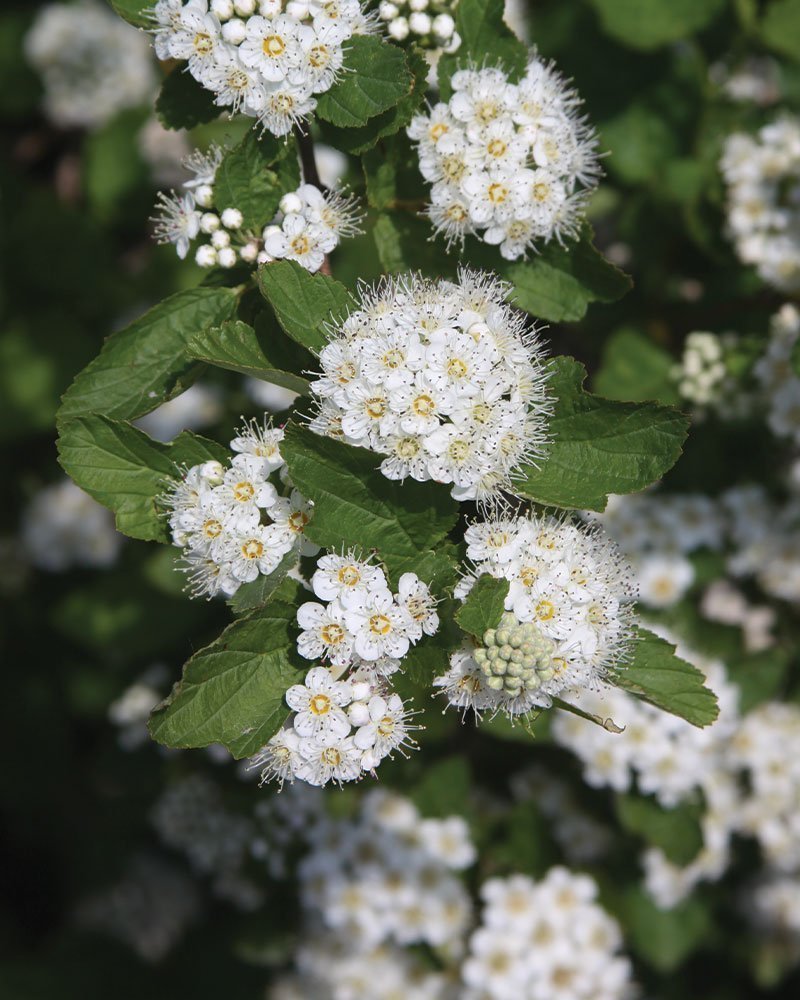
Ninebark can be planted in almost any type of soil or light conditions. It is drought tolerant once established. Fairly fast growing. It reaches a height of 6-10 feet tall, but can be pruned to any shape or size to meet the needs of almost any landscape. The most popular cultivar is probably Diabolo with dark red leaves (above right). It has pure white flowers that bloom from May until the end of June. The small flowers are a great standout against the rich burgundy foliage. Another cultivar is Dart’s golden ninebark, a more compact shrub with light striking yellow spring foliage fading to a chartreuse yellow-green in summer. It has showy white flowering clusters in early summer and fantastic golden-orange fall color.
Ninebark can be propagated from cuttings or seeds which germinate readily. It is best to plant adult plants in the spring or fall. The boiled bare roots of ninebark were used by Indians of the southwestern US to relieve pain of sores and lesions, as a poultice. The gardens in front of the Marshall library have several ninebark ‘Diabolo’ plants in the landscape.
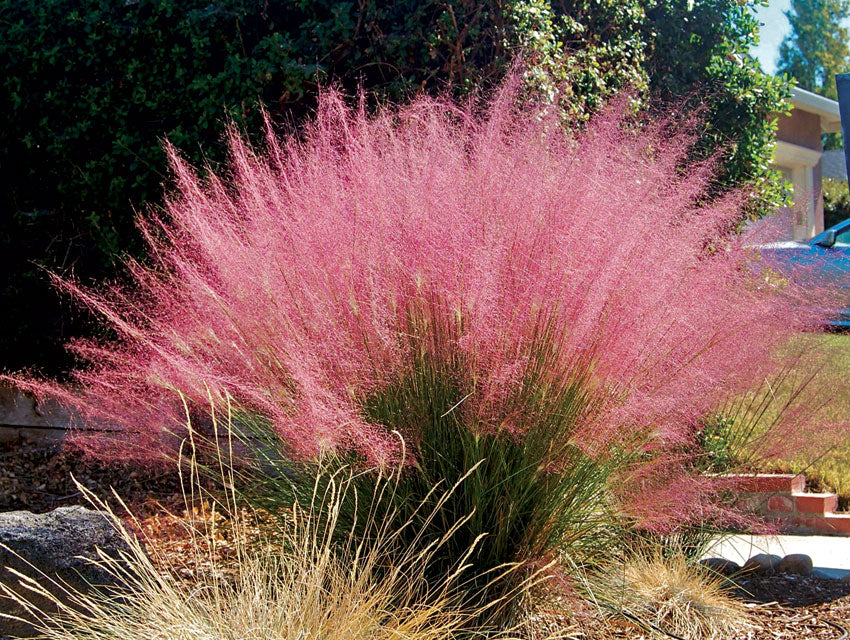
A stunning specimen! Throughout the summer, it produces a round clump of bright green stems that look like many other grasses. But just as your summer perennials are winding down, this native begins to put on it’s glorious display. Rosey-pink plumes grow on the 3 foot stems and look like fluffy clouds that make it a show-stopper.
Pink muhly grass grows to 4 feet tall and arches out to a width of 3+ feet. It likes full sun but can grow nicely in part shade. It is remarkably hardy and can stand poor, but well drained soil, drought, heat and humidity.
It has few problems with insects and a long life. This is an almost perfect plant for a border or in mass. Don’t apply fertilizer, compost or manure as the plants do nicely on their own. Until recently, this grass was not offered in most nurseries, but it’s popularity has spiked and is now often hard to find. It is very easy to propagate from seed, however. If you know someone who grows it, simply brush your hand along the stem after the seeds have turned brown and you’ll have thousands of seeds ready to plant after drying for 5-10 days. In spring they can be planted indoors in flats or sown directly outside. Seedlings will need to be thinned so that the tiny plants will not crowd each other out. Established clumps can be divided, but its best to wait until late spring or early summer while they are actively growing. Look around and you’ll likely find that some of the seeds have sprouted nearby. These can be easily transplanted.
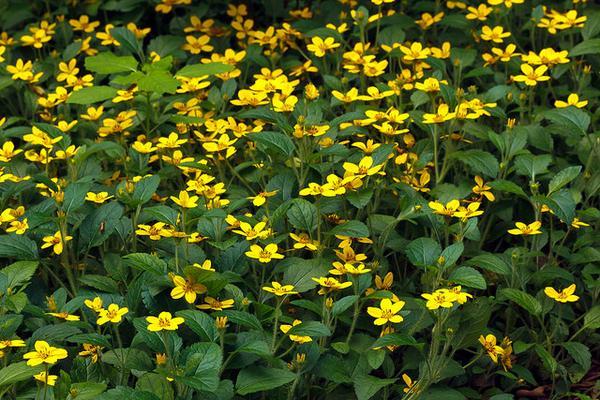
March’s native plant selection is Green & Gold, Chrysogonum virginiana. A native groundcover that is a real workhorse. It takes sun or shade and can live in wet or dry soil. Green & gold has tons of little yellow flowers blooming in early spring and again in the fall, slowing down during the heat of summer. Spreading by runners, it can cover a wide area of ground but is easy to control. It reaches 6-12 inches in height. Hardy in zones 5-10. It’s a good front of the garden or understory plant.Looking for more info? check it out at http://plants.usda.gov/java/profile?symbol=chvi5 or http://www.wildflower.org/plants/result.php?id_plant=CHVI5
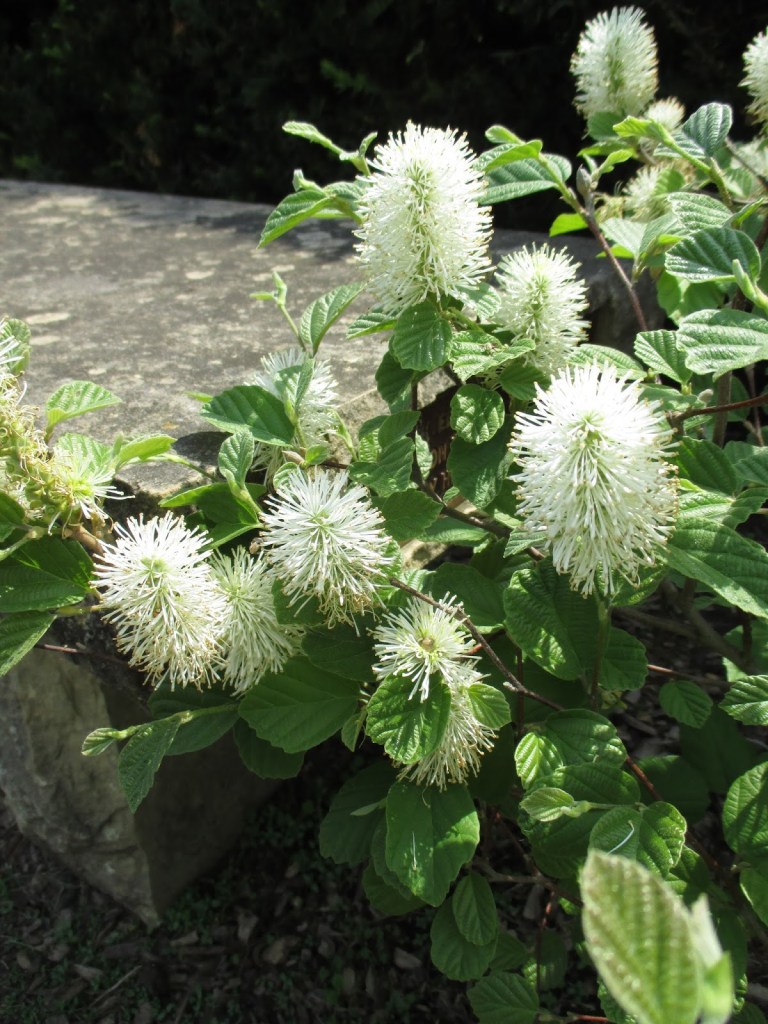
Witch-alders do well in moist, well-drained, slightly acidic soil and can be planted in full sun to part shade. It will not tolerate limey soil conditions. Once established, they are drought tolerant as well as low maintenance. In early spring, the fragrant white “bottlebrush” flowers appear at the ends of the winter branches.
Planted in more sun, it will be bushier as well as more floriferous. In hot climates, witch-alder will require shade during hot afternoon sun. Witch-alder will need a moister soil in hotter climates. Hardy in zones 4-8. Witch-alder seeds can be started in a coldframe in fall and allowed to overwinter outside. Softwood tip cuttings taken in summer can be rooted under mist. Witch-alder can also be propagated by air-layering.
Once abundant, the Witch-alder is now listed as threatened in several states.
 Marshall Native Gardens