By Rita Pelczar *
- NOTE: Rita is longtime volunteer for MNG and a well known national writer
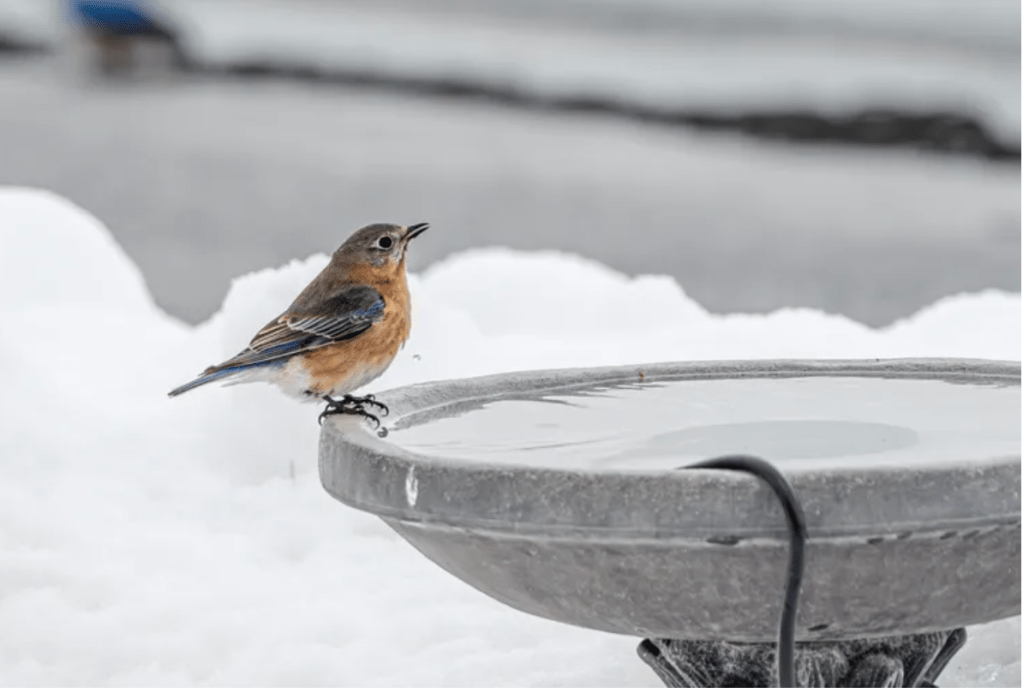
In addition to filling your bird feeders with seed and suet, providing birds with water is often overlooked, especially in winter when ice and snow make other water sources less available. We strongly recommend also planting lots of native plants that are bird friendly!
Experts tell us that your bird bath should be shallow, heated, kept filled, and cleaned regularly. For additional details, please check out a Rita’s BETTER HOMES & GARDENS Jan. 7th 2026 article summarized below:
1. Select a Suitable Bird Bath
According to McKinney, a good bird bath should be shallow. The basin should resemble a shallow puddle, similar to what birds find in nature. If your bird bath is deeper, add some rocks so birds have a safe place to perch as they go for a drink.
Concrete or ceramic bird baths may crack with alternate freezing and thawing, and they are more difficult to clean. A shallow plastic bird bath with a gentle slope is a better option, especially in winter. “The bird bath does need to be able to tolerate possible freezing if the power goes out,” McKinney points out.
2. Find a Good Site for Your Bird Bath
Many birds prefer a bath that sits on the ground, however, if cats wander into your yard, a bath that sits a few feet off the ground may be safer.
Place your bird bath in the shade of nearby trees and shrubs. This not only prevents rapid evaporation of the water on sunny days but gives birds a handy place to escape to if predators appear. Be sure to place it where you can enjoy watching your avian visitors from indoors.
3. Use a Heated Bird Bath
“We attract birds to our backyard in Orange County, North Carolina, all winter using a heated bird bath,” says McKinney. These bird baths are equipped with a heater you can plug into an outdoor socket. Use a ground fault circuit interrupter (GFCI), available from hardware stores. McKinney warns that “the temperature needs to be well regulated, so you don’t end up with boiled chickadee stew.”
There are lots of different styles and sizes, including those that attach to decks, those that sit on the ground, and those that are supported by a stand. And since birds are attracted to moving water, some include a fountain, which may be solar-powered.
4. Add De-Icer to the Water
To stop the water in your bird bath from freezing, place a simple immersion-style heater made specifically for bird baths in the water. The devices are relatively inexpensive to buy and to operate. It’s best to find one that is thermostatically activated when temperatures drop below freezing and automatically shuts off if there is no water in the bath.
5. Skip Any Additives
“We don’t recommend putting any extras in the water, such as glycerin to prevent freezing, algae or mosquito control products, etc., as they can be harmful to birds and other critters,” explains Joe Liebezelt, a staff scientist and avian conservation manager with the Bird Alliance of Oregon.
Not only are these chemicals harmful if ingested, but glycerin may also cause feathers to become matted, which reduces their ability to insulate birds against cold temperatures.
6. Keep the Bird Bath Filled
“Exchange the water every 3 or 4 days, depending on what falls into your bird bath. We get leaves and lots of caterpillar excrement from the trees over the bird bath, so I exchange the water every 2 or 3 days,” says McKinney. “Our bird bath has a hinge, which makes emptying it easy,” he notes.
7. Clean the Bird Bath Regularly
Scrub your bird bath regularly with baking soda, white vinegar, or lemon juice and rinse it thoroughly. “If cleaning and maintaining a bird bath is too much work, it’s best to let the birds forage for other water sources on their own,” recommends Liebezelt. “A dirty bird bath is more harmful than helpful if not maintained properly,” he emphasizes.
Enjoy your feathered friends and keep your cats indoors!!!

 Marshall Native Gardens
Leave a comment