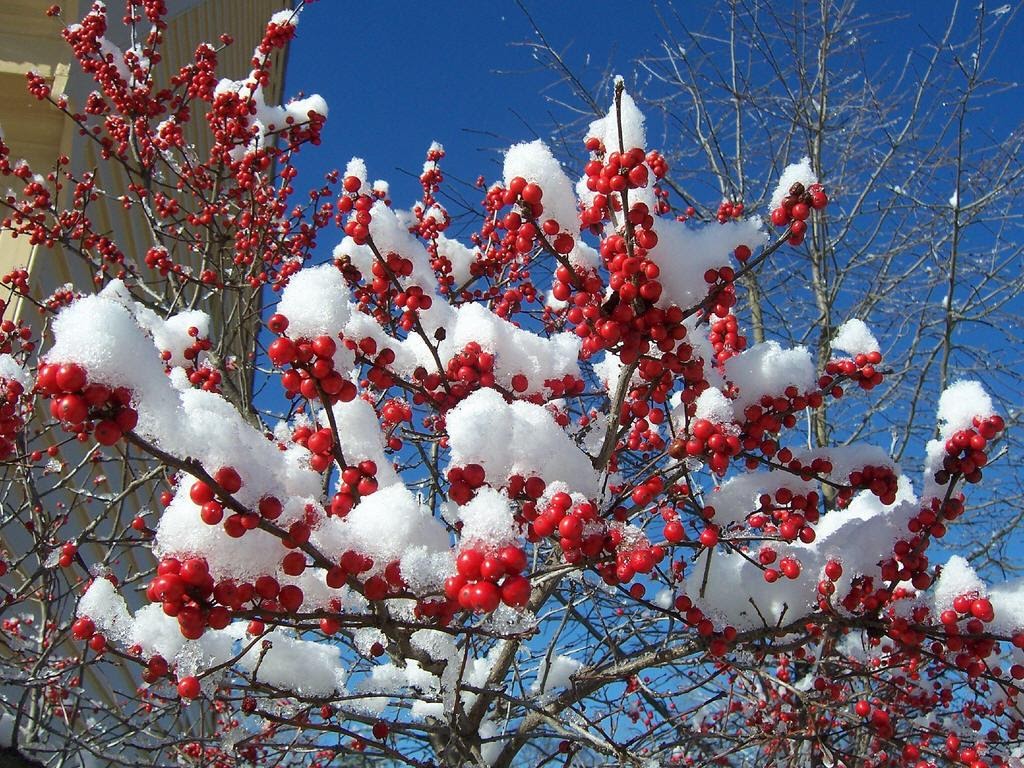
American winterberry is a beautiful, ornamental, multi-stemmed shrub. Hardy in zones 3 through 9. It is also called black alder, brook alder and fever bush and is a member of the holly family. It is native to eastern Canada and the eastern half of the United States. Rarely reaching over 12 feet tall with an oval to rounded, upright shape. It tends to spread by suckering and forms large colonies. Winterberry is an easy to grow but tough shrub which can grow in average soil but prefers acidic soils and wetlands. It’s often found at the edge of woods or swamps. It grows well in either full sun or part shade, but more sun promotes better berry production.
The leaves are finely toothed, glossy green leaves, narrow and oblong, turning shades of yellow, maroon or brown in fall before dropping off. In late spring and early summer, small, whitish, greenish or yellowish, inconspicuous flowers bloom on the axils. They are followed by a spectacular display of bright red berries so vivid it’ll make you stop and take notice.
As with most hollies, male and female plants are needed to produce berries. One male plant will be sufficient to fertilize a dozen female plants within a 40 foot radius. Flowers appear on new growth, so any pruning should be done in late winter to early spring. Identification between male and female hollies can only be positively accomplished by examining the flowers. Take a close look at the flowers, specifically, at what protrudes from their centers. Male holly flowers have 4 yellow stamens, each female holly flower has a green ovary (bump). For berries on Ilex verticillata, try one of these male pollinators, ‘Southern Gentleman’ or ‘Jim Dandy’.
Winterberry hollies are an excellent source of food for numerous species of songbirds as well as small mammals, wild turkeys, and quail. They are also eaten by white-tailed deer. Stems are often collected in November before the songbirds strip the fruit. The berry-laden branches are prized by arts and crafts enthusiasts for use in such items as floral arrangements, wreathes, kissing balls and winter window boxes.
 Marshall Native Gardens
Leave a comment